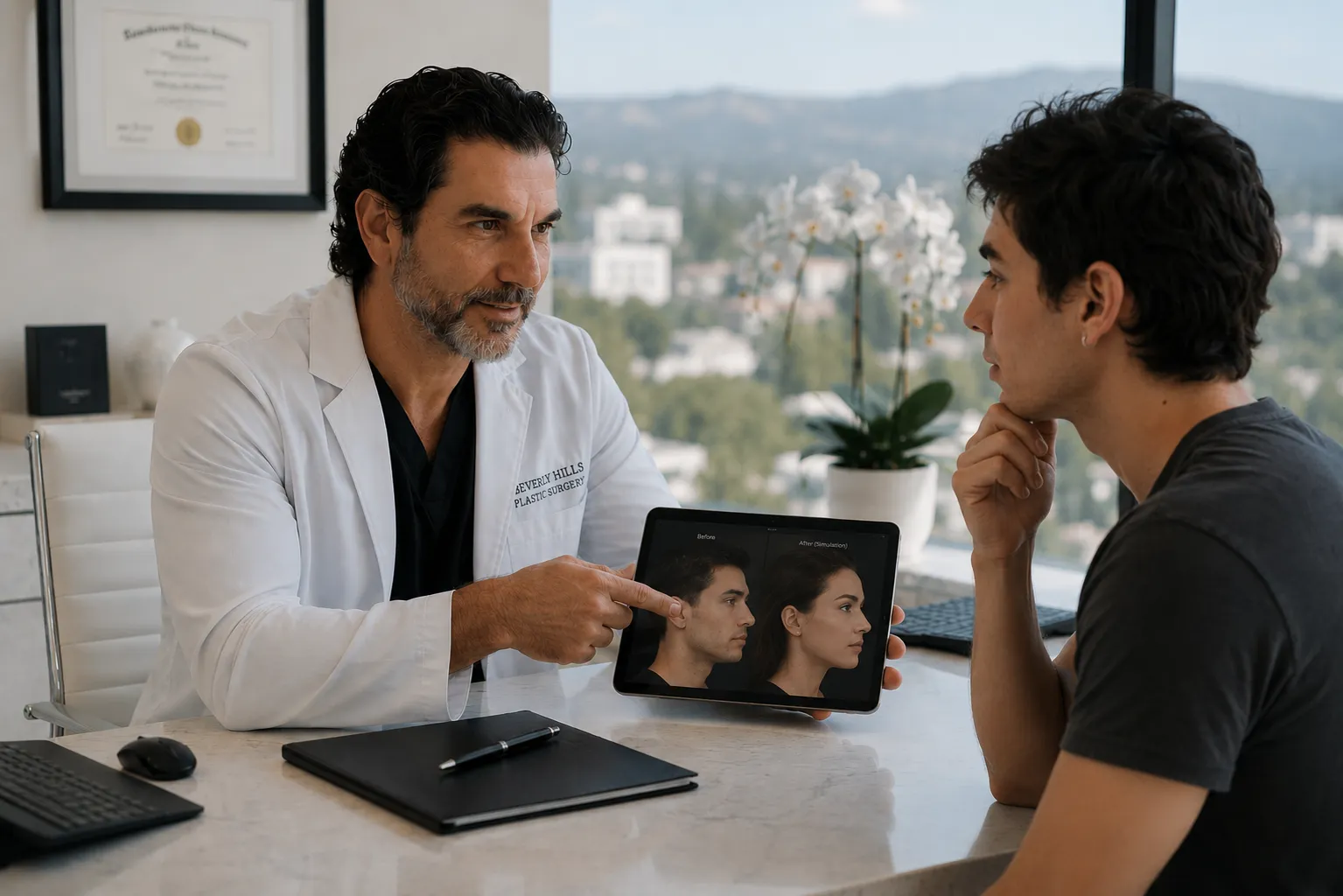
Gender affirming body contouring is a considered set of surgical and non-surgical procedures that reshape the body to more closely reflect a person's gender. It may involve refining the waist and hips, softening or strengthening the chest wall, redistributing fat along the thighs or shoulders, or sculpting the jawline and neck. For many, the goal is not transformation for its own sake, but coherence — a quiet alignment between how one is read and how one already is.
Why this matters is worth sitting with. Clothing fits differently. Reflections stop startling. The daily, low-grade work of explaining oneself to a mirror begins to ease. Research consistently links body-related dysphoria with heightened anxiety and social withdrawal, and its resolution with meaningful, durable improvements in wellbeing.
What follows is not a brochure. It is an honest look at what these procedures involve, who they suit, and the questions worth asking before anything is scheduled.
What Is gender affirming body contouring?
Gender affirming body contouring is a set of surgical and minimally invasive procedures that reshape the body so its outward form more closely matches a person's gender identity. It sits within the broader field of gender affirming care, alongside hormonal therapy and other surgical options, but focuses specifically on silhouette — the curves, angles, and proportions that read as feminine, masculine, or non-binary at a glance.
The scope is genuinely wide. For those seeking a more feminine shape, contouring often involves fat transfer to the hips, thighs, and buttocks, waist refinement through liposuction, and sometimes breast augmentation to complete the upper-body line. For a more masculine outcome, the work tends to move in the opposite direction: chest masculinisation, flattening of the hips, and sculpting through the flanks, chest wall, and abdomen to build a squarer, straighter torso. Non-binary approaches draw from both, tailored to the individual rather than a template.
What sets this work apart from standard cosmetic surgery is its context. The goal is not enhancement for its own sake but alignment — reducing the daily friction between how someone feels and how they are seen. Planning is usually collaborative, involving the surgeon, the person themselves, and often a wider care team who understand the medical, emotional, and social dimensions involved.
Approached thoughtfully, gender affirming body contouring is less about transformation as spectacle and more about arriving, quietly, at a version of the body that finally feels like home.
Key Benefits of gender affirming body contouring
 %22%2F%3E%0A%20%20%3Cg%20transform%3D%22translate(666%20410)%20scale(8.542)%22%20fill%3D%22none%22%20stroke%3D%22%23f9fafb%22%20stroke-width%3D%222%22%20stroke-linecap%3D%22round%22%20stroke-linejoin%3D%22round%22%20opacity%3D%220.3%22%3E%0A%20%20%20%20%3Crect%20x%3D%223%22%20y%3D%223%22%20width%3D%2218%22%20height%3D%2218%22%20rx%3D%222%22%2F%3E%0A%20%20%20%20%3Ccircle%20cx%3D%229%22%20cy%3D%229%22%20r%3D%221.8%22%2F%3E%0A%20%20%20%20%3Cpath%20d%3D%22M21%2015l-5-5L5%2021%22%2F%3E%0A%20%20%3C%2Fg%3E%0A%20%20%3Ctitle%3EKey%20Benefits%20of%20gender%20affirming%20body%20co%3C%2Ftitle%3E%0A%3C%2Fsvg%3E)
For many, the reflection in the mirror hasn't always matched the person within. Gender affirming body contouring offers a considered path toward resolving that quiet dissonance—shaping the silhouette so it reads, at a glance, as your own.
The most immediate benefit is proportion. Through a combination of liposuction, fat transfer, and targeted sculpting, the waist, hips, chest, and shoulders can be refined to reflect a more masculine, feminine, or non-binary form. Results are tailored rather than templated, honouring the individual anatomy you begin with.
Beyond aesthetics, there is the ease of daily life. Clothing sits differently. Movement feels less negotiated. The small, constant adjustments many people make—layering, binding, posturing—often soften or fall away entirely. That reclaimed mental space is, for most patients, the quietest and most profound outcome.
There is also the matter of longevity. Unlike temporary measures, contouring produces lasting structural change. Fat redistribution and refined contours remain stable with a settled weight, which means the investment continues to serve you for years rather than seasons.
Psychological wellbeing tends to follow. Research consistently links gender-affirming procedures with reductions in dysphoria, improved self-image, and greater comfort in intimate and social settings. These are not promises of transformation so much as the removal of a persistent obstacle between you and your own life.
Discretion is another advantage worth naming. Contouring can be approached in stages, with recovery managed privately, and the results themselves need never be announced. For those who prefer their journey to remain personal, this quiet quality is often the deciding factor.
Finally, the process is collaborative. A thoughtful consultation allows you to articulate the outcome you want in your own language—and to be met, without assumption, exactly where you are.
How gender affirming body contouring Works
%22%2F%3E%0A%20%20%3Cg%20transform%3D%22translate(666%20410)%20scale(8.542)%22%20fill%3D%22none%22%20stroke%3D%22%23f9fafb%22%20stroke-width%3D%222%22%20stroke-linecap%3D%22round%22%20stroke-linejoin%3D%22round%22%20opacity%3D%220.3%22%3E%0A%20%20%20%20%3Crect%20x%3D%223%22%20y%3D%223%22%20width%3D%2218%22%20height%3D%2218%22%20rx%3D%222%22%2F%3E%0A%20%20%20%20%3Ccircle%20cx%3D%229%22%20cy%3D%229%22%20r%3D%221.8%22%2F%3E%0A%20%20%20%20%3Cpath%20d%3D%22M21%2015l-5-5L5%2021%22%2F%3E%0A%20%20%3C%2Fg%3E%0A%20%20%3Ctitle%3EHow%20gender%20affirming%20body%20contouring%20Wor%3C%2Ftitle%3E%0A%3C%2Fsvg%3E)
Gender affirming body contouring reshapes the silhouette through a sequence of considered steps, each one guided by your goals and anatomy. The process begins well before the operating room, with a private consultation to understand what you want your body to reflect. Photographs, measurements, and sometimes 3D imaging help map the areas where volume should be reduced, added, or redistributed — hips, waist, chest, thighs, buttocks, shoulders.
From there, a surgical plan is drafted. This plan is specific to you: the ratios, the transitions between regions, the balance between softness and definition. Nothing is templated. If fat transfer is part of the approach, donor sites are chosen to serve both the removal goal and the augmentation goal simultaneously.
On the day of the procedure, small, carefully placed incisions allow access to the treatment areas. Liposuction is used to sculpt — removing fat from regions where a more tapered or angular line is desired, or where existing volume interrupts the intended shape. The extracted fat, when needed, is purified and prepared for transfer. It is then reintroduced in fine layers to build curvature where the body reads flatter than you'd like. In some cases, implants or soft tissue rearrangement are integrated to achieve proportions that fat alone cannot deliver.
Throughout, the surgeon works in three dimensions, stepping back frequently to assess symmetry, flow, and how each area relates to the next. The aim is not exaggeration but coherence — a body that moves and reads as one.
Recovery unfolds over weeks and months. Compression garments support the tissues as they settle, swelling recedes gradually, and the transferred fat establishes its blood supply. The final contour reveals itself slowly, quietly, becoming the version of you that felt true all along.
Common Questions About gender affirming body contouring
What exactly is gender affirming body contouring? It's a set of surgical techniques used to reshape the torso, hips, waist, chest, or buttocks so the body reads more closely to how you experience yourself. Depending on your goals, that may involve liposuction, fat transfer, implants, muscle definition, or a combination.
Am I a candidate? Most healthy adults with stable weight and realistic expectations are. Your surgeon will discuss medical history, hormone timelines, body composition, and any planned future procedures before recommending an approach.
Do I need to be on hormones first? Not always. Hormones can shift fat distribution over time, so many people wait 12–24 months before contouring to see where their body settles naturally. Others choose to proceed sooner. It's a conversation, not a rule.
How long is recovery? Expect one to two weeks away from work for lighter procedures, and three to six weeks before returning to full activity. Compression garments are usually worn for six to eight weeks. Final results settle over three to six months as swelling resolves.
Will there be visible scars? Incisions are placed thoughtfully — often within natural creases or areas easily covered. Scars mature and fade considerably over the first year.
Is the result permanent? The reshaping is long-lasting, though significant weight changes, aging, and pregnancy can affect outcomes. Maintaining a stable weight helps preserve your result.
How private is the process? Consultations, records, and recovery arrangements are handled with full discretion at every stage.
Conclusion
Gender affirming body contouring is a considered process, not a single moment. The right outcome depends on thoughtful planning, an experienced surgical team, and a recovery approach that respects both your body and your privacy.
A few things worth holding onto: results are shaped as much by technique and anatomy as by aftercare. Timelines vary. Swelling settles slowly, and the silhouette you see at six weeks is rarely the one you keep at six months. Honest conversations during consultation — about goals, limits, and lifestyle — tend to produce the most satisfying results.
If you are ready to explore what this might look like for you, the next step is straightforward: book a private consultation. Bring your questions, your reference points, and your concerns. You will leave with a clearer sense of what is possible, what it involves, and whether the timing is right.